

ForesightXL vs traditional forecasting
ForesightXL vs Traditional Forecasting
AI forecasting does not have to mean replacing finance models with a black box. ForesightXL is a lightweight forecasting assistant that works alongside traditional Excel and FP&A workflows: it keeps a deterministic mathematical baseline independent of AI, then uses AI to interpret business context and apply explained numerical adjustments by forecast period.
ForesightXL is not a replacement for traditional forecasting discipline. It is a lightweight assistant that helps finance teams rapidly test how business context should adjust a deterministic baseline before updating formal Excel models, forecast workbooks, or FP&A platform workflows.
Traditional forecasting gives finance teams structure, control, and modelling discipline. ForesightXL helps teams rapidly test how business context should change the forecast, engage the business and leadership, identify where management attention should go, and carry an agreed view into the existing forecasting workflow.
Traditional forecasting helps control the model. ForesightXL helps challenge, explain, and iterate the forecast view before that model is updated.
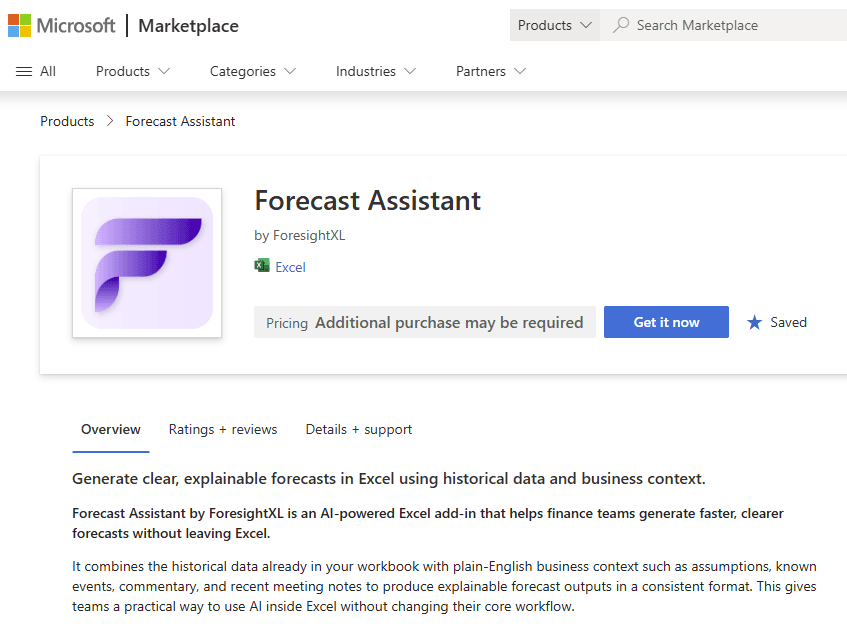
Available now in Microsoft Marketplace. $19 USD/month. New users get 5 free forecasts.
What is the difference between AI forecasting and traditional forecasting?
Traditional forecasting typically uses formulas, statistical methods, driver models, manually maintained assumptions, forecast workbooks, and FP&A platform workflows. ForesightXL combines traditional forecasting discipline with AI-assisted context interpretation: the baseline remains mathematical and independent of AI, while the AI converts business context into explained numerical adjustments.
The strongest use case for ForesightXL is not replacing the finance model. It is helping teams rapidly build, explain, challenge, and iterate a forecast view before that view is used in a formal model, manually maintained forecast workbook, or planning platform.
Forecast discipline vs forecast judgement
Traditional forecasting remains essential when finance teams need detailed models, statistical discipline, driver logic, governance, and final forecast ownership.
But traditional forecasting can become slow when the business context changes faster than the model. New customer information, pricing decisions, operational constraints, market changes, leadership assumptions, or stakeholder feedback often need to be interpreted before the formal model is updated.
ForesightXL is designed for that judgement step. It helps finance teams start from a deterministic mathematical baseline, add plain-English business context, review explained adjustments, and rapidly test how the forecast view should change.
Traditional forecasting helps control the model. ForesightXL helps challenge, explain, and iterate the forecast view before that model is updated.
Compare traditional forecasting with ForesightXL
Traditional forecasting still matters
ForesightXL is not positioned as a replacement for robust finance models, statistical discipline, or full FP&A platforms. Those tools remain important when teams need governed planning workflows, detailed driver logic, consolidations, controls, approvals, reporting, and final model ownership.
Detailed financial models
Use traditional models when you need detailed driver logic, explicit formula control, and full spreadsheet ownership.
Governed planning systems
Use FP&A platforms for workflow, consolidation, permissions, approvals, reporting, and process control.
Stable statistical patterns
Traditional statistical methods are useful when historical data is stable and business context is limited.
Final forecast governance
Finance teams still need controlled processes for final budgets, forecasts, management reporting, and executive sign-off.
Where ForesightXL fits
ForesightXL fits in the judgement and conversation stage of forecasting: when teams need to combine actuals with new business context, understand the potential impact, and test alternatives quickly with stakeholders.
Before updating the model
Generate a first view before committing changes to a detailed workbook, model, or FP&A system.
During business review
Use explained outputs to discuss assumptions with sales, operations, leadership, finance, or business partners.
For scenario iteration
Change the context, rerun the forecast, and compare the impact quickly.
To reach consensus
Use the structured forecast to help the business agree on a view before formalising it elsewhere.
To test new assumptions quickly
Rapidly test how new pricing, demand, capacity, market, customer, or leadership assumptions could affect the forecast.
To focus management attention
Use the forecast explanation to understand which drivers, risks, periods, or assumptions deserve leadership focus.
How ForesightXL works alongside traditional forecasting
1. Start with historical data
Use the historic time series already maintained by finance or the business.
2. Generate an independent baseline
ForesightXL maintains a deterministic mathematical baseline independent of the AI context layer.
3. Interpret business context
Paste text or drop in supporting material such as PDFs, notes, or business updates; the AI interprets the context and converts it into forecast adjustments.
4. Review explained adjustments
Review how the context changed the deterministic baseline through explained numerical adjustments by period.
5. Iterate with the business
Discuss assumptions, compare scenarios, challenge the output, and refine the forecast view with business stakeholders and leadership.
6. Use the agreed output where appropriate
After review and iteration, the consensus forecast can inform traditional Excel models, forecast workbooks, reporting packs, or FP&A platforms.
Work out the forecast view before you update the model
Traditional forecasting gives finance teams the structure, control, and governance needed to own the final forecast. ForesightXL helps with the earlier judgement step: working out how business context should affect the forecast before the formal model is updated.
Use ForesightXL to rapidly test assumptions, engage the business and leadership, identify where management attention should go, and carry an agreed forecast view into your traditional forecasting workflow.
Common use cases for AI-assisted forecasting
ForesightXL is useful when historical data and business context both matter, and when finance teams need to explain forecast movements clearly before they update formal models or planning tools.
Rolling forecast refreshes
Update forecasts quickly when new actuals arrive or assumptions change.
Scenario planning
Test base, upside, downside, pricing, demand, capacity, or market assumptions with stakeholders.
Revenue forecasting
Combine revenue history with business context such as pricing, pipeline, churn, retention, and seasonality.
Demand forecasting
Forecast demand, volume, usage, orders, or customer activity using historical data and current context.
Forecast challenge sessions
Use the baseline and explained adjustments to challenge whether the current forecast view is too optimistic, too conservative, or missing known business context.
Leadership forecast reviews
Use ForesightXL to turn the forecast into a discussion. Show what changed, which assumptions matter, where the risks are, and which areas need leadership attention.
Related use cases
Explore how teams apply ForesightXL across common forecasting workflows.
Related comparisons
Compare other approaches to forecasting in Excel.
Frequently Asked Questions
Answers to common questions about AI forecasting versus traditional forecasting.
What is the difference between AI forecasting and traditional forecasting?
Traditional forecasting relies on formulas, statistical methods, models, and manual assumptions. ForesightXL combines a deterministic baseline with AI-interpreted context and fully explained numerical adjustments by period.
Does ForesightXL replace traditional forecasting models?
No. ForesightXL is designed to be used alongside existing Excel models and FP&A systems. It helps teams reach a fast, explainable forecast view that can then inform those tools.
How does ForesightXL support forecast judgement?
ForesightXL helps finance teams interpret business context, test assumptions, review explained adjustments, and understand how the forecast view should change before updating formal models or planning systems.
How does ForesightXL avoid black-box forecasting?
ForesightXL keeps the mathematical baseline independent of AI. The AI layer interprets context and applies explained numerical adjustments to that baseline, allowing users to review and challenge the result.
Can ForesightXL support scenario discussions with the business?
Yes. Users can rapidly adjust context, rerun forecasts, compare results, and use the explained output to help the business and leadership discuss assumptions, understand key drivers, and reach consensus.
What happens after the business agrees with a ForesightXL forecast?
The agreed forecast can be used where appropriate in traditional Excel models, reporting packs, budget workflows, or full FP&A platform solutions.
Ready to test forecast assumptions before updating the model?
Get started freeWork out the forecast view before you update the model
Use ForesightXL to rapidly test assumptions, engage the business and leadership, identify where management attention should go, and carry an agreed forecast view into your traditional forecasting workflow.