

Five Advantages of Scenario-Based Forecasting
Scenario Forecasting using AI in Excel
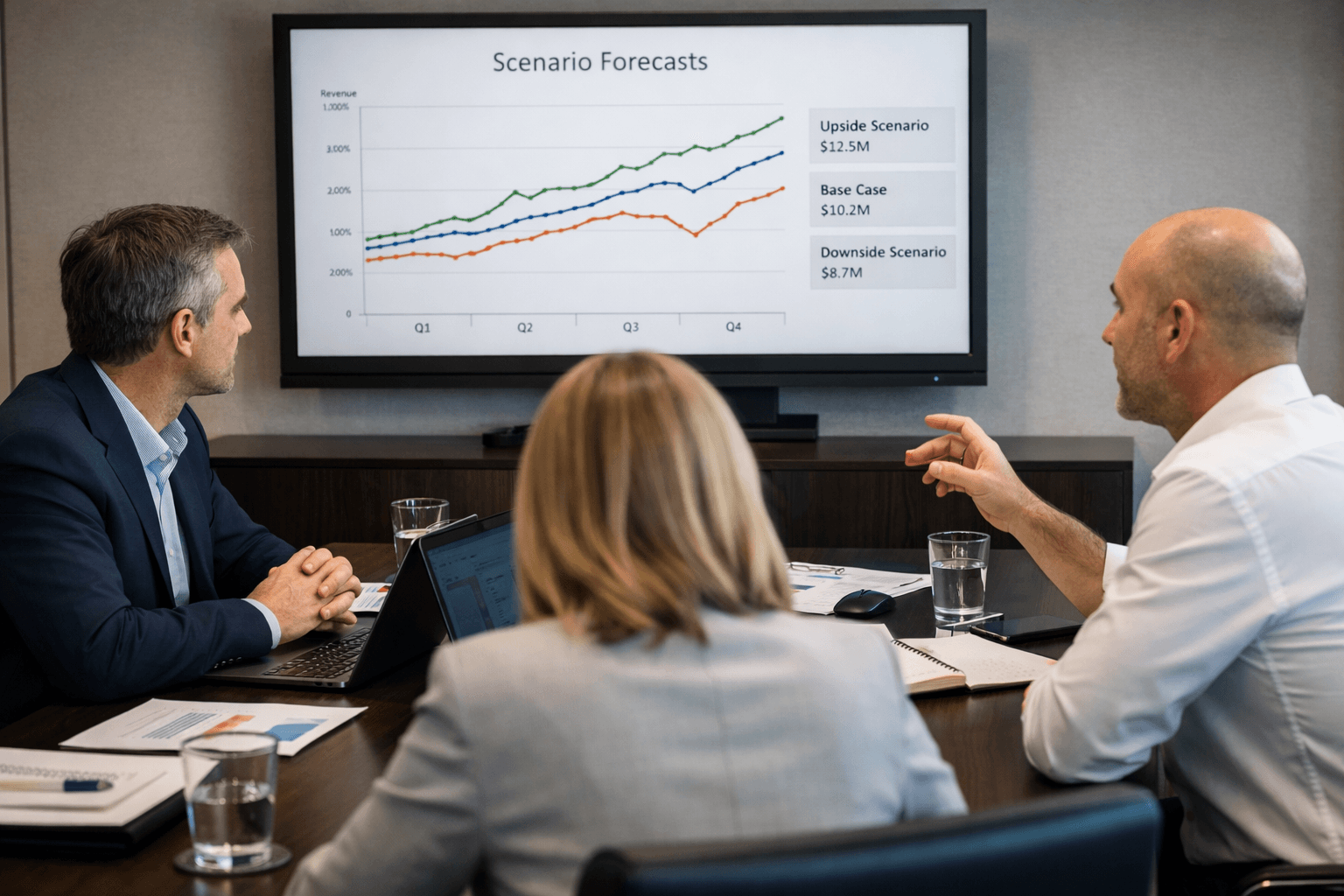
Scenario Forecasting using AI in Excel
Most forecasts still land on a single number.
Next year, revenue will be $243.4 million.
It appears precise, but business rarely behaves that way.
Deals slip. Costs shift. One-off events distort the trend. When everything is blended into a single output, it becomes difficult to distinguish what came from the data and what came from judgement.
Scenario-based forecasting solves that problem by making uncertainty explicit rather than implicit.
The ForesightXL Five Factor Forecast Framework formalises this separation by distinguishing:
- Mathematical Baseline
- Recurring Effects
- Business Drivers
- Operating Constraints
- Strategic Adjustments
Each component has a defined origin. Evidence remains separate from managerial intent.
The Mathematical Baseline is reproducible. Given the same dataset, it will produce the same result. It reflects the underlying trend and recurring patterns present in the time series.
Business context is then layered explicitly on top.
Once that separation exists, financial scenario modelling becomes clean, fast, and repeatable.
1. You Stop Treating Uncertainty as an Exception
Many forecasts implicitly assume stability. Conditions stay stable, risks are minor, the future resembles the past.
Scenario-based forecasting reverses that logic. Instead of smoothing uncertainty away, you test it directly.
What if renewals are delayed?
What if a major contract slips?
What if two bids convert simultaneously?
Under the Five Factor Framework, uncertainty lives in context, not hidden inside growth rates.
For example, a baseline forecast might indicate around 620 chargeable hours per month based on recent delivery patterns. A consultant absence in April can then be applied explicitly as an operating boundary, while expected work from a large client in June is added as a business driver. The baseline remains anchored in the data, while the scenario shows how specific business context changes the outlook.
The same principle applies when historical data includes a one-off spike caused by a unique event. The deterministic baseline will reflect what happened, but the adjustment layer accounts for the fact that the event will not recur.
Instead of rewriting history, you adjust forward expectations explicitly.
Change the context in natural language. Re-run the forecast. Observe how the components move.
The baseline remains intact. The assumptions are visible.
If you want a practical guide to choosing that baseline and writing better assumptions, see Choosing the Right Baseline Method in ForesightXLand What Good Forecasting Context Looks Like.
2. You Separate Evidence from Expectation
A common forecasting weakness is not poor modelling. It is blurred logic.
Historical performance, management ambition, and strategic intent often become embedded in the same formula.
Scenario modelling works best when these elements remain distinct.
The Mathematical Baseline is generated directly from the time series and remains reproducible for a given dataset.
Future-facing assumptions like new contracts, pricing changes, hiring plans belong in Business Drivers or Strategic Adjustments, not embedded inside trend calculations.
When this structure is preserved, forecasting scenarios become controlled tests.
You are not asking whether the forecast is correct.
You are asking what happens if a specific assumption changes.
That improves discipline immediately.
3. Scenario Modelling Becomes Fast Enough to Use
In many organisations, scenarios are avoided because they are operationally expensive.
Models are duplicated.
Formulas are edited.
Logic becomes fragile.
Assumptions are hard-coded.
The complexity associated with this traditional architecture matters. The effort required to test or review the potential impact of a new idea or some other possible change often means it simply does not happen.
With ForesightXL’s Five Factor Forecast Framework, you do not rebuild the model for each scenario; You adjust contextual inputs in plain English and re-run the forecast. That helps finance test assumptions, explore decisions, and keep forecasting aligned with the latest business thinking.
The baseline forecast remains anchored in the time series. AI assists in interpreting business context and structuring adjustments on top of that anchor. It does not replace the mathematical foundation.
When forecast context is broad or open to interpretation, ForesightXL generates three clarification suggestions to refine the provided context before the forecast is rerun. This reduces ambiguity, speeds up iteration, and often leads to the most valuable forecasting conversations.
This allows rapid simulation of base cases, downside conditions, capacity constraints, and strategic initiatives without destabilising the underlying model.
Financial scenario modelling becomes fast enough to use in live discussions rather than as a post-meeting exercise.
4. Conversations Improve, Not Just Outputs
Scenario-based forecasting shifts finance from defending a number to exploring outcomes.
Instead of arguing over whether a forecast is right or wrong, leadership can examine which drivers move results materially, where downside risk is concentrated, and which actions change trajectory.
Because ForesightXL keeps the baseline reproducible and each adjustment explicit, stakeholders can see the relationship between evidence, assumptions, and outcomes.
This creates alignment between finance, operations, and leadership. It also reduces the pressure to smooth forecasts for political reasons.
5. Simulations Support Decisions, Not Just Reporting
Forecasts should inform decisions before commitments are made.
Scenario simulation allows you to test strategic adjustments directly, increasing marketing spend, delaying shipments, adjusting pricing, applying operational limits, or modelling the loss or win of a major client.
Each scenario produces an explained result grounded in historical evidence and structured context.
The baseline does not change unless the data changes. Scenarios reflect deliberate changes in business context, described in natural language and translated by AI into the forecast through the ForesightXL Five Factor Forecast Framework.
Forecasting becomes proactive rather than retrospective.
Why Scenario-Based Forecasting Is Easier with ForesightXL
The difference is architectural.
ForesightXL separates reproducible evidence from contextual judgement.
The Mathematical Baseline is reproducible, while business context is layered explicitly and transparently through Recurring Effects, Business Drivers, Operating Constraints, and Strategic Adjustments.
The output remains inside your spreadsheet, every number is explained, and the process stays transparent and controlled.
That structure enables one model, multiple futures, clear reasoning, and fast iteration.
Simulating a scenario becomes a thinking exercise rather than a technical rebuild.
Final Thought
The future is uncertain. That is not a flaw in forecasting. It is the reason scenario modelling exists.
Structured scenario-based forecasting does not eliminate uncertainty. It makes it visible, testable, and decision-ready.
When evidence and judgement remain separate, simulations become simple. And when simulations become simple, they become useful.