

5 Practical Forecasting Lessons
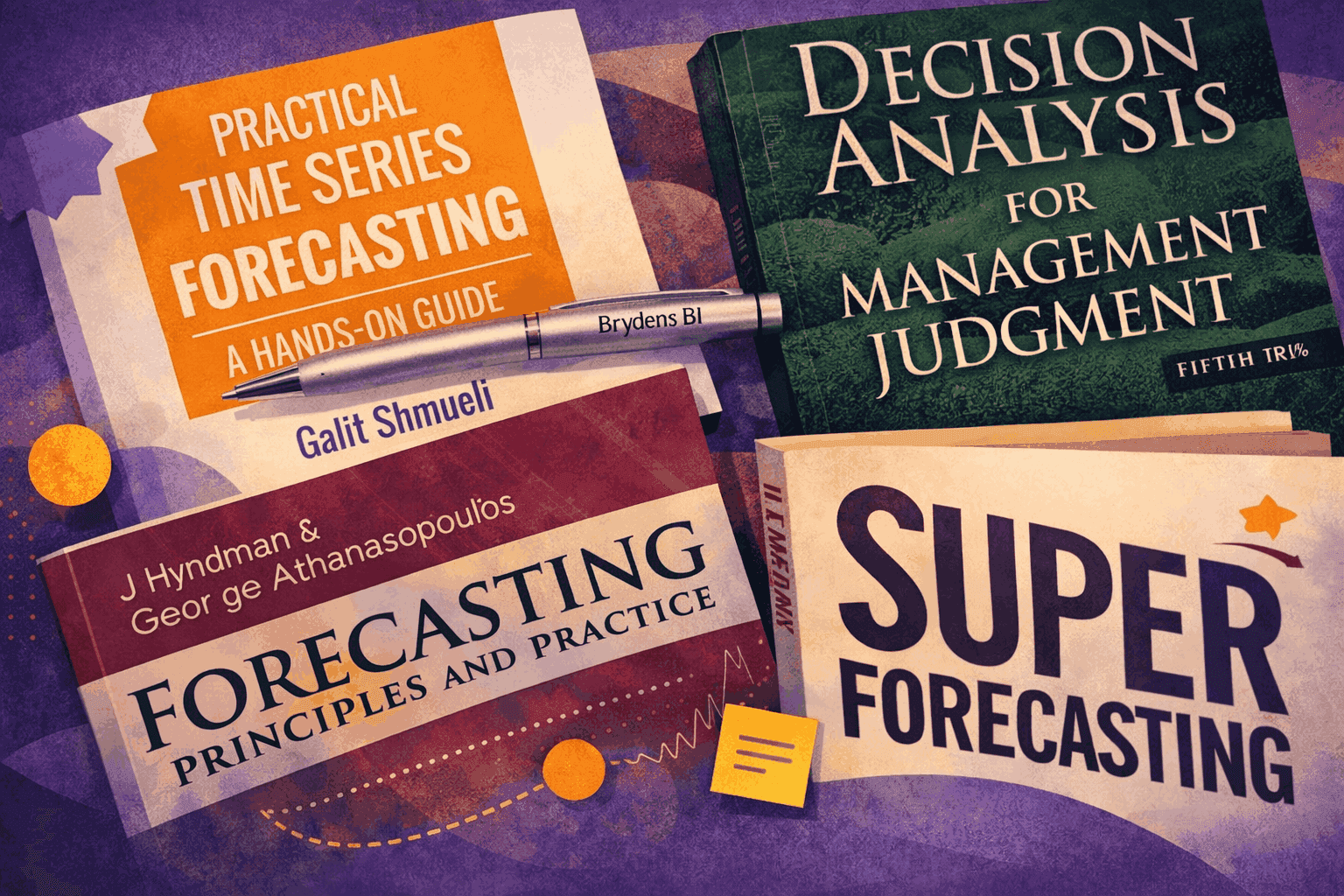
What Forecasting Books Teach About AI Forecasting in Excel
Many forecasting resources focus heavily on mathematics or advanced modelling techniques. Far fewer focus on what makes forecasts effective in real organisations: disciplined process, structured thinking, and continuous validation.
One book that addresses this directly is Practical Time Series Forecasting – A Hands-On Guide. Its strength lies in translating statistical concepts into operational practice.
For finance teams using structured AI forecasting in Excel — particularly through the ForesightXL Forecasting Assistant — its lessons are highly relevant.
Below are five practical lessons, reframed for AI-supported forecasting in Excel.
1. Start with the Data, Not the Model
Effective forecasting begins with understanding the data.
Before selecting a method, you must ask:
Is there a clear underlying trend?
Is seasonality present?
Are there outliers or one-off events?
Has the structure of the series changed?
In the ForesightXL Five Factor Forecast Framework, this principle is foundational.
The Mathematical Baseline is generated deterministically from the historical time series. Given the same dataset, it produces the same numerical results. These results become the statistical anchor.
AI does not replace this step. It supports the interpretation of business context, expressed in natural language, layered explicitly on top of it.
Forecasting quality improves when the data is understood before assumptions are introduced.
2. Simple Models Often Perform Surprisingly Well
A recurring lesson in forecasting research is that simple models frequently rival complex ones, particularly when data is stable or limited.
Naïve methods and exponential smoothing often provide strong benchmarks. Complexity should be introduced only when it demonstrably improves forward performance.
For AI forecasting in Excel, this reinforces an important mindset. The objective is not algorithmic novelty. It is measurable improvement over a simple, explainable benchmark.
ForesightXL reflects this by anchoring forecasts in a statistically grounded baseline and layering structured assumptions, derived from natural language business context, through:
- Recurring Effects
- Business Drivers
- Operating Constraints
- Strategic Adjustments
Sophisticated forecasting absolutely has its place. In certain environments, specialist modelling is required. But disciplined structure is a prerequisite to complexity, not a substitute for it.
3. Validation on Unseen Data Is Essential
A model that fits history perfectly may simply be overfitting noise.
The real test of a forecast is how it performs on data it has not yet seen.
In practice, this means:
- Comparing against simple baselines
- Avoiding assumption tuning to match recent actuals
- Reviewing performance as new data arrives
- Maintaining structural consistency over time
Within ForesightXL, the deterministic baseline remains stable unless the data changes. Adjustments are explicit and traceable. This makes forward validation clearer.
For CFOs, this distinction matters. Forecasts must demonstrate reliability in live operating environments, not just retrospective elegance.
4. Trend and Seasonality Must Be Explicit
Time series data often contains structure:
- Long-term trend
- Seasonal patterns
- Cyclical movement
- Irregular noise
Ignoring these components introduces systematic error.
The Five Factor Framework separates these elements deliberately. The Mathematical Baseline captures the underlying trend, seasonality, and cyclical movement. While plain English business context is used to layer on top the other factors such as recurring effects, drivers, constraints, and strategic adjustments.
This separation improves both accuracy and explainability.
In management discussions, this changes behaviour. Rather than debating isolated numbers, teams can discuss structural drivers and contextual adjustments, and they can do this in plain English.
Forecasting becomes analytical rather than defensive.
5. Forecasting Is a Process, Not a One-Off Exercise
Forecasting is iterative.
Models must be updated, monitored, and reassessed as new data arrives. Markets change. Strategies evolve. Assumptions require refinement.
Because ForesightXL operates directly inside Excel, finance teams can:
- Update actuals
- Re-run forecasts
- Compare scenarios
- Adjust assumptions
- Document changes
This supports continuous refinement rather than static reporting, including the ability to capture updated assumptions in plain English as business conditions change.
Across organisations, forecasting maturity improves not through increasing algorithmic complexity, but through embedding repeatable and transparent process.
Final Reflection
The central message of Practical Time Series Forecasting is clear: forecasting effectiveness depends more on disciplined practice than algorithmic novelty.
For teams applying AI forecasting in Excel, the practical lessons are:
- Understand the data before modelling
- Benchmark against simple approaches
- Validate forward, not just historically
- Make trend and seasonality explicit
- Treat forecasting as an ongoing process
AI can accelerate analysis and standardise structure. But the real value lies in combining deterministic statistical grounding with structured business context.
When forecasting is transparent, structured, and iterative, it becomes more than a projection.
It becomes a reliable decision-support discipline.