

How Context-Driven Forecasting Improves Traditional FP&A Forecasts
Context-Driven Forecasting in Excel for FP&A Managers
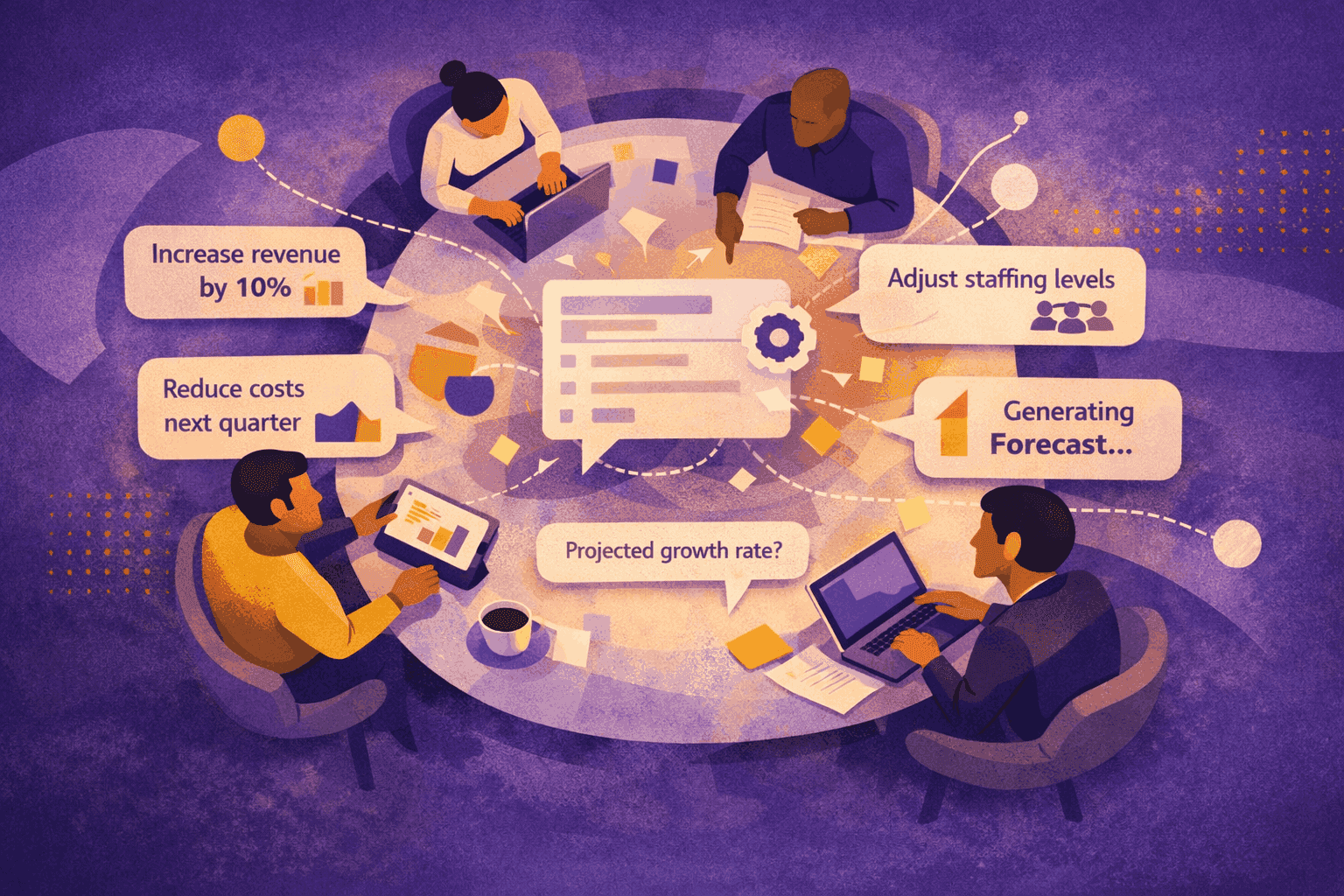
Traditional forecasting remains essential for FP&A teams.
It provides structure, consistency, and a common framework for planning. It supports budgeting, reporting, performance reviews, and communication with leadership. In most organisations, it is still the foundation of how finance teams model the future.
That is not the problem.
The issue is that business decisions are rarely made in stable conditions. Demand changes. Costs shift. Hiring plans move. Pricing assumptions evolve. Competitor behaviour changes. Leadership priorities can change quickly. A forecast can be technically sound and still become less useful if it does not reflect what is actually happening in the business.
This is where context-driven forecasting adds value.
It does not replace traditional forecasting. It strengthens it. It helps FP&A managers bring business context into the forecasting process using natural language, alongside explicit assumptions and practical scenario thinking, so forecasts become more useful for decisions, not just reporting.
Using AI, teams can provide context in natural language, including meeting notes, executive observations, and other plain English business updates that would otherwise sit outside the model.
Traditional Forecasting Still Matters
Traditional forecasting has an important role because it creates discipline.
It helps finance teams compare actuals to plan, align around common assumptions, and maintain consistency across reporting periods. It also creates repeatable processes that can be understood across finance, operations, and leadership.
Most FP&A teams have invested heavily in these models. They are embedded in planning cycles, management reporting, and accountability processes.
That is why the goal is not to replace traditional forecasting. It is to make it more useful when leaders need it most.
Where Traditional Forecasts Fall Short
A traditional forecast often reflects historical trends plus a set of planned assumptions. That works well when conditions are relatively stable.
But leaders rarely want only a forecast number. They want to understand what sits behind it. Which assumptions matter most. What risks could change the outcome. How sensitive the result is. What actions the business should consider next.
That creates a gap between producing a forecast and using one.
Finance may have modelled the forecast correctly, but if it does not connect clearly to current business conditions, it can become difficult to explain, difficult to defend, and difficult to act on.
A revenue forecast may look reasonable based on historical run rates. But if price increases are being tested, a product launch has slipped, or conversion has softened in one channel, leadership does not just want the updated number. They want to understand how those changes affect the outlook and what might happen if conditions shift again.
What Context-Driven Forecasting Adds
Context-driven forecasting strengthens traditional forecasting by allowing FP&A teams to bring business context into the process in plain English, not just through spreadsheet adjustments. That context might include operational changes, commercial developments, strategic priorities, market conditions, or management assumptions.
Using AI, teams can describe that context in plain English and bring it closer to the forecast itself. That makes it easier to clarify what has changed, what matters most, and what should be tested.
The forecast is no longer just a projection of what might happen. It becomes a structured way to test how changing business conditions could influence outcomes.
That improves the quality of the conversation around the forecast. Leaders can move beyond asking, “What is the number?” and ask better questions about what is driving it, what could move it, and what the business should prepare for.
If you want to strengthen the baseline and the quality of the assumptions, see Choosing the Right Baseline Method in ForesightXLand What Good Forecasting Context Looks Like.
Why Assumptions and Scenarios Matter
Forecasting always depends on assumptions. The problem is not that assumptions exist, but that they are often buried in spreadsheet logic, weakly tested, or hard to explain clearly.
Context-driven forecasting helps make those assumptions more visible by allowing teams to express business context in natural language. It gives finance teams a clearer way to express management views and test how specific changes affect the forecast.
That also makes scenario analysis more credible.
Instead of building mechanical upside and downside cases, teams can build scenarios around realistic business conditions: a delayed launch, a slower hiring ramp, supplier disruption, pricing pressure, or stronger demand in one segment.
This makes scenario analysis more useful because it is grounded in how the business actually operates. It also makes the conversation easier for leadership to engage with, because it is no longer only about spreadsheet outputs. It becomes a discussion about possible business conditions and how the organisation might respond.
That is where FP&A adds real value. Finance moves from owning the model to helping shape the decision.
Explainability Matters as Much as Accuracy
In executive settings, explainability is critical.
A forecast may be statistically reasonable, but if it cannot be explained clearly, confidence in it will be limited. FP&A managers are often expected to present the number, explain the drivers, defend the logic, and answer “what if” questions in real time.
That is difficult when reasoning is buried inside disconnected calculations or undocumented assumptions.
Context-driven forecasting improves explainability by creating a clearer link between outputs, assumptions, drivers, and current business conditions. Using natural language to capture business context makes that logic easier to express and defend. Leaders can see not only the result, but the logic behind it.
That builds trust.
Trust is what makes a forecast useful. A forecast will never remove uncertainty, but when decision-makers understand how it was formed, what it depends on, and what could change it, they are far more likely to use it with confidence.
Why This Matters in Excel-Based FP&A Workflows
For most FP&A teams, Excel remains the natural home of forecasting.
It is familiar, flexible, and deeply embedded in finance processes. It is where many planning models already live, and where outputs from other planning tools are often brought for review, analysis, and decision support.
That is why improving forecasting inside Excel matters so much.
It allows finance teams to strengthen existing models rather than replace them. They can add natural language business context, make assumptions more explicit, test scenarios more realistically, and improve explainability without abandoning the workflows they already trust.
This is also where tools like ForesightXL become especially relevant. By helping teams bring natural language context, assumptions, and scenario thinking directly into Excel-based forecasting, ForesightXL supports a more practical and usable form of forecasting improvement inside the environment finance teams already use every day.
Better Forecasts Support Better Decisions
The purpose of forecasting is not just to produce a number. It is to support better business decisions.
Traditional forecasting still plays an essential role in that process. But on its own, it is often not enough. In fast-moving business conditions, finance teams need forecasts that reflect not only historical evidence, but also the realities, assumptions, and uncertainties shaping the business right now.
That is the value of context-driven forecasting.
It helps FP&A managers improve traditional forecasts by bringing business context closer to the model through natural language, making assumptions clearer, scenarios more realistic, and forecast outputs easier to explain and defend.
Most importantly, it helps finance provide leadership with insight that is more actionable, more credible, and more relevant to the decisions ahead.
For FP&A managers, the opportunity is clear: keep the strengths of traditional forecasting, but make forecasts more useful where they matter most — in the decisions the business makes next.