

What Good Forecasting Context Looks Like
Turning business assumptions into clearer forecast adjustments and better scenarios
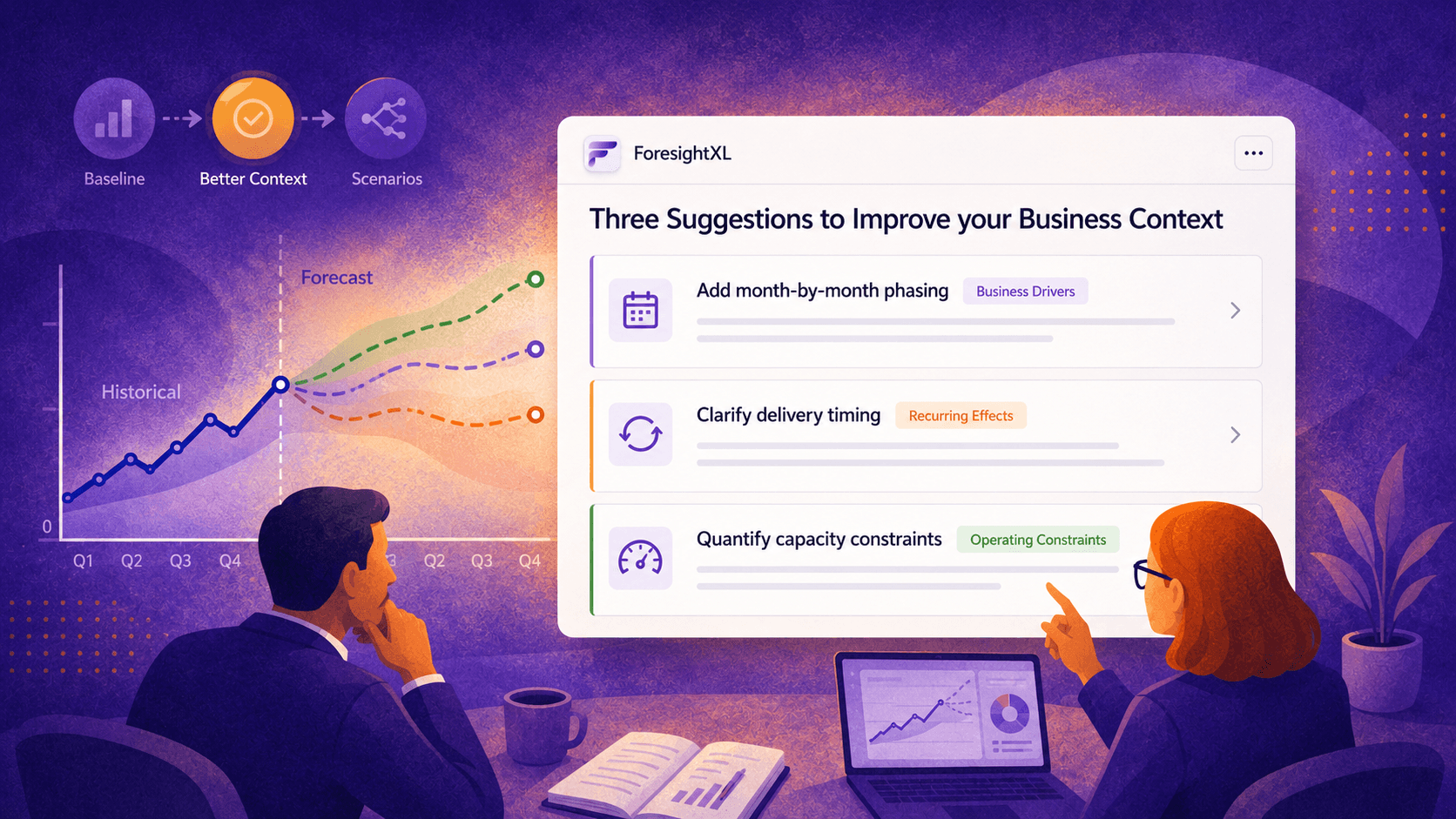
A forecast becomes more useful when the historical baseline is combined with clear business context. The baseline shows what the historical data suggests. Business context explains why the future may differ from that history.
That distinction matters. A forecast based only on historical data may miss a customer delay, a price change, a campaign launch, a capacity constraint, a supplier cost increase, or a management decision that has not yet appeared in the numbers. Those developments can be highly relevant, but they are not always easy to capture in a traditional forecasting process.
ForesightXL is designed to help finance teams work with both layers. Users can start with historical data in Excel, choose a baseline method, add plain-English business context, and review explained forecast adjustments. The quality of that context matters because clearer assumptions usually lead to clearer scenarios, better review conversations, and more useful forecast outputs.
History is only the starting point
Historical data provides the foundation for a forecast. It shows past levels, trends, seasonality, volatility, and changes in run rate. That foundation is important because it creates a disciplined starting point.
But history does not automatically know what the business knows. It cannot know that a major customer is likely to delay an order, that a new sales campaign starts next month, that a supplier contract is about to change, or that a product launch is expected to ramp up slowly.
This is where business context becomes valuable. It helps explain what may change, when it may change, and why the forecast should move away from the historical baseline. If you are still deciding how to build the baseline, see Choosing the Right Baseline Method in ForesightXL.
What is forecasting context?
Forecasting context is the plain-English information that explains what is happening in the business and how it may affect the forecast. It is the bridge between the historical baseline and the business view of the future.
Useful forecasting context may include:
- commercial assumptions;
- sales pipeline commentary;
- customer risks and opportunities;
- pricing decisions;
- marketing or demand generation activity;
- operational constraints;
- supply or fulfilment issues;
- staffing or capacity changes;
- known one-off events;
- management expectations;
- timing changes; and
- market or competitor developments.
Context is not a replacement for historical data. It is the information that helps explain where the historical pattern may need to be adjusted.
Why vague context produces weaker forecasts
Business context only becomes useful when it is specific enough to interpret. A forecast user may know that something is changing, but if the context is too vague, it is difficult to turn that knowledge into a clear forecast adjustment.
Examples of weak context include:
- Sales should improve.
- Costs may be higher.
- Demand could soften.
- The pipeline looks better.
- There is some risk in Q4.
These statements may be directionally useful, but they leave too much unanswered. What line item is affected? When does the impact start? How large might the impact be? Is it temporary or ongoing? Is the assumption confirmed, likely, or speculative? Is it part of the base case, or is it a downside scenario risk?
The better the context, the easier it is to turn business judgement into an explainable forecast adjustment.
Weak context vs strong context
Good forecasting context does not need to be complicated. It does need to be specific enough to guide the forecast.
| Weak context | Stronger context |
|---|---|
| Sales should improve next quarter. | Sales are expected to increase by 8-10% in Q3 because a new campaign launches in July. |
| Costs will be higher. | Supplier costs increase by 6% from September under the new contract. |
| Demand may soften. | Downside risk is concentrated in Q4 if two enterprise renewals slip into next year. |
| The pipeline looks strong. | Three late-stage deals worth approximately $400k are expected to close between August and October. |
| Marketing is increasing. | Marketing spend increases by $40k in Q2, with expected lead impact from June onward. |
| There is some churn risk. | One customer representing 7% of monthly recurring revenue is at risk from November. |
The stronger examples explain what changes, when it changes, why it changes, and how large the impact might be. That makes them easier to review, challenge, and convert into forecast logic.
The six ingredients of useful forecasting context
A simple way to improve forecasting context is to check whether it covers six practical ingredients.
1. Affected line item
The context should identify which part of the forecast is affected. This might be subscription revenue, professional services revenue, units sold, gross margin, customer churn, support costs, headcount costs, or chargeable hours.
Without the affected line item, the forecast may know that something matters, but not where the adjustment belongs.
2. Direction
The context should explain whether the assumption is expected to increase or decrease the forecast. A campaign may increase demand. A price rise may increase revenue but reduce volume. A supplier change may increase cost. A delivery constraint may cap revenue even when demand exists.
3. Timing
Timing is often one of the most important parts of forecasting context. The same assumption can have a very different effect depending on whether it starts in July, September, or the following financial year.
Useful context might say that an impact starts from September onward, lasts for Q3 only, phases in over six months, or has been delayed by one quarter.
4. Magnitude
Magnitude gives the forecast a sense of scale. The context does not always need to be exact, but it should give a useful range where possible.
Examples include a 5-8% uplift, a $100k to $150k revenue delay, a 3% margin reduction, or 20 additional units per month.
5. Confidence
Not every assumption has the same level of certainty. A signed contract is different from an early sales estimate. A confirmed supplier increase is different from a possible market risk.
Calling out confidence helps distinguish confirmed assumptions from likely outcomes, early estimates, management judgement, and downside risks.
6. Source
Good context also explains where the assumption came from. Sources might include a sales pipeline review, supplier contract, board decision, customer conversation, operations update, or management estimate.
This makes the forecast easier to review. If the assumption is challenged, the team knows where to go for more detail.
How context becomes a forecast adjustment
In ForesightXL, the user starts with historical data, chooses a baseline method, and then adds business context in plain English. The AI interprets that context and converts it into forecast adjustments that can be reviewed by period.
The important point is not just that the forecast changes. The important point is that the reason for the change is visible. A context-driven adjustment should be traceable back to the assumption that caused it.
This makes the process more useful for finance teams. Instead of only asking whether the final number is right, the team can ask better questions: was the assumption interpreted correctly, is the timing reasonable, is the scale too high or too low, and should this be part of the base case or a scenario? For a deeper FP&A lens, see How Context-Driven Forecasting Improves Traditional FP&A Forecasts.
Three Suggestions to Improve your Business Context
One of the useful parts of the ForesightXL workflow is that each forecast output includes Three Suggestions to Improve your Business Context. These suggestions are designed to help users sharpen the assumptions behind the forecast rather than simply accept the first result.
This matters because the first version of business context is often incomplete. A user may describe a new customer ramp, a strong order book, or a capacity risk, but leave out the monthly timing, the affected line item, the source, or the likely scale of the impact.
The suggestions help identify what would make the context more useful. They may ask for more detail about a monthly split, a rolling delivery schedule, a customer renewal date, a pricing assumption, a capacity limit, or a clearer view of which team owns the input.
For example, the suggestions might highlight questions such as:
- A growth assumption is clear, but the month-by-month bridge is missing. Adding the expected monthly phasing would improve the business driver context.
- Secured work or committed demand is strong, but the timing is unclear. Adding a rolling delivery schedule would improve the recurring effects context.
- Demand exists, but capacity constraints are not quantified. Adding fill rates, staffing assumptions, or capped demand by month would improve the operating constraints context.
This is especially useful for scenario forecasting. Instead of building scenarios from arbitrary percentage changes, users can improve the context, rerun or refine the forecast, and create scenarios from clearer business assumptions.
In that sense, ForesightXL is not just producing a forecast. It is helping users improve the reasoning behind the forecast.
Why scenarios should be assumption-led
Scenarios are more useful when they are built from specific assumptions rather than broad percentage changes. A weak scenario approach is to take the base forecast and apply a simple uplift or reduction, such as plus 10% for upside and minus 10% for downside.
That may be quick, but it is not very informative. It does not explain what would actually need to happen for the upside or downside to occur.
A better scenario approach is assumption-led:
- Base case: the most likely business assumptions.
- Upside case: favourable but plausible assumptions.
- Downside case: identifiable risks that may affect the forecast.
- Stress case: a more severe but still plausible combination of risks.
This approach creates better forecast conversations because stakeholders can discuss the assumptions, not just the final numbers. For more on why this improves decision-making, see Five Advantages of Scenario-Based Forecasting.
A brief worked example
Suppose a business has created a baseline revenue forecast. The historical data has already been reviewed, and the team has selected a suitable baseline method. The next step is to add business context.
The initial context might say:
Sales are expected to improve because of a new campaign, several large opportunities are in the pipeline, and a key customer renewal is uncertain later in the year.
This is useful, but still incomplete. It gives direction, but not enough timing, magnitude, or confidence. A stronger version might say:
A new campaign launches in July and is expected to increase qualified leads from August. Three late-stage opportunities worth approximately $400k are expected to close between August and October, with medium confidence. One customer renewal representing 7% of monthly recurring revenue is at risk from November if the commercial terms are not agreed.
That stronger context supports clearer scenarios.
Base case
The campaign launches on time, one large opportunity closes in Q3, and the customer renewal is delayed by one month but still closes.
Upside case
The campaign performs above expectation, two or three large opportunities close, and the customer renewal is completed on time.
Downside case
Campaign impact is delayed, the large opportunities slip into the next quarter, and the customer renewal moves into the following year.
Stress case
Pipeline timing slips, the renewal risk materialises, and operational capacity limits the business from recovering the shortfall quickly.
Each scenario is clearer because it is built from business assumptions that can be reviewed, challenged, and updated.
A simple forecasting context template
A simple structure can make forecasting context easier to provide and easier to review.
| Field | Example |
|---|---|
| Scenario | Downside case |
| Affected line item | Enterprise revenue |
| Business assumption | Major customer renewal slips |
| Direction | Decrease |
| Timing | September to November |
| Estimated impact | -$120k to -$180k |
| Confidence | Medium |
| Source | Sales pipeline review |
| Owner / reviewer | Head of Sales |
This structure does not need to become an administrative burden. Its purpose is to make assumptions visible. If the assumption is visible, the forecast can be reviewed more effectively.
Common mistakes when adding forecasting context
Forecasting context is most useful when it is clear and reviewable. Some common mistakes reduce that usefulness.
- Providing vague context without timing or magnitude. Direction alone is rarely enough to create a good forecast adjustment.
- Mixing confirmed assumptions with speculative risks. A signed contract should not be treated the same way as an early opportunity.
- Not identifying the affected line item. The context needs to explain where the forecast should change.
- Applying scenario adjustments without explaining the driver. Scenarios should be linked to business assumptions, not just percentage changes.
- Treating the first AI-adjusted forecast as final. The first result should usually be reviewed, challenged, and refined.
- Forgetting to update assumptions. Business context can change quickly as new information arrives.
- Creating too many scenarios without a decision purpose. Each scenario should help answer a useful business question.
How ForesightXL supports context-driven scenarios
ForesightXL supports a workflow that keeps the forecast connected to both the data and the reasoning behind the forecast.
A practical workflow is:
- Start with historical data in Excel.
- Choose a baseline method.
- Add business context in plain English.
- Review the explained forecast adjustments.
- Read the Three Suggestions to Improve your Business Context.
- Clarify missing assumptions, timing, scale, or ownership.
- Rerun or refine the forecast using better context.
- Create scenarios by changing assumptions rather than manually forcing the final number.
- Compare the adjusted forecast back to the baseline.
This workflow helps make the forecast more transparent. The business can see not only the output, but also the logic that shaped the output.
FP&A teams can also explore a practical use case in AI Forecasting for FP&A.
That is useful in finance conversations because it moves the discussion away from whether the number simply feels right and towards whether the assumptions are complete, reasonable, and current.
Conclusion
A baseline forecast is useful because it shows what history suggests. Business context is useful because it explains why the future may differ from that history. Scenarios become more valuable when they are built from clear assumptions rather than arbitrary uplifts or reductions.
Good forecasting context does not need to be complicated. It needs to be specific, reviewable, and connected to the business. It should explain what is changing, when it changes, how large the impact might be, how confident the team is, and where the assumption came from.
ForesightXL helps by turning plain-English business context into explained forecast adjustments and by providing suggestions to improve that context further. This creates a better forecasting loop: start with the baseline, add context, review the adjustments, improve the assumptions, and build scenarios that are easier to explain.
When teams describe their assumptions clearly, forecasts become easier to review, easier to challenge, and easier to improve.
For step-by-step guidance on running these workflows in Excel, the ForesightXL User Guide is the best place to start.